Klondike Solitaire Turn 1
The Classic, One-Card-at-a-Time Experience
Turn 1 is what most people picture the moment you say the word Solitaire. When I think back to all those hours I spent playing on my first computer in the early 90s, it was always this mode — one card at a time, the full deck visible as you work through it, that satisfying click as every card finally finds its place. There is something deeply calming about knowing nothing is hidden from you. The challenge is not finding the cards; it is figuring out the right order to use them.
Turn 1 is the standard draw mode on Klondike Solitaire at CardAndPuzzle.com. You can switch between Turn 1 and Turn 3 at any time using the Game button in the interface. This page covers everything specific to the Turn 1 experience — how the draw mechanic works, why it changes the feel of the game, how to score well, and the strategies that make the most of full stock visibility.
How the Turn 1 Draw Mechanic Works
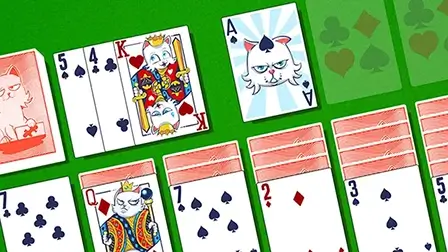
The setup for Turn 1 is identical to all Klondike variants. A standard 52-card deck is dealt into seven tableau columns, with column one holding one card (face up) through to column seven holding seven cards (six face down, one face up). The remaining 24 cards form the stock pile in the upper left, and four empty foundation spaces sit ready to receive each suit from Ace through King.
The key distinction is in the stock pile. Each time you tap or click the stock:
- Exactly one card is moved face up to the waste pile.
- That card is immediately available to play onto the tableau or the foundations.
- The next tap reveals the next card in the stock.
When the stock is exhausted, you flip the waste pile back over to form a new stock and draw through it again. There is no limit to how many times you cycle through the deck. This is the crucial difference from Turn 3: in Turn 1, every single card in the deck will eventually sit on top of the waste pile, accessible and playable, as you work through successive passes.
Nothing gets permanently buried. If you cannot play a card right now, you know it will come back around — you just need to ensure the tableau is in the right shape to receive it when it does.
Why Turn 1 Feels Different to Play
The one-card draw creates a fundamentally different rhythm compared to Turn 3. The game opens up earlier, decisions arrive more frequently, and you rarely feel stuck simply because the right card is inaccessible. This does not make Turn 1 trivial — games are still winnable less than a third of the time in practice — but it shifts the source of challenge from access to sequencing.
In Turn 3, a large portion of the difficulty comes from cards you cannot reach. Key pieces are often locked three positions down in the waste pile, forcing you to plan around their absence. Turn 1 eliminates that problem almost entirely. The challenge is purely about the order of your moves: when to send a card to the foundation, when to hold it in the tableau as a building block, when to clear a column for a King.
For beginners, this distinction is enormously helpful. You can focus on learning the core Klondike logic — alternating colors, descending order, suit-based foundations — without simultaneously fighting to excavate buried stock cards. For experienced players, Turn 1 offers a more meditative experience: clean problem-solving with full information, where a loss is always traceable to a specific decision rather than an unfair draw.
Win Rate at a Glance
- Turn 1 win rate (standard play): approximately 30–35%
- Turn 3 win rate (standard play): approximately 15–20%
- Roughly 82% of all Klondike deals are theoretically solvable with perfect play — the gap between theoretical and practical win rates reflects human decision-making, not impossible deals
Scoring in Turn 1 Mode
The scoring system is the same across both draw modes. Understanding how points accumulate helps you approach each game with the right priorities.
Points Per Move
- +10 points — Moving any card to a foundation pile (from the tableau or the waste pile)
- +5 points — Playing a card from the waste pile onto the tableau
- +5 points — Flipping a face-down tableau card face up
- −10 points — Moving a card back from a foundation pile to the tableau
Time Bonus
After completing a game that takes at least 30 seconds, a time bonus of 700,000 ÷ completion time in seconds is added to your score. Finish in four minutes (240 seconds) and you receive roughly 2,916 bonus points. Finish in two minutes (120 seconds) and you receive nearly 5,833 bonus points.
Because Turn 1 games tend to resolve faster than Turn 3 — you are not repeatedly hunting through a multi-card stock for buried pieces — the time bonus is a realistic target in this mode. Players who know the game well can complete Turn 1 games in under three minutes on favorable deals, pushing total scores above 1,000 points easily.
The −10 penalty for returning a foundation card to the tableau is steep, and in Turn 1 it is rarely necessary. Because you have direct access to every stock card, the situations where you genuinely need to break a foundation are uncommon. Reserve that move for genuine emergencies.
Turn 1 Strategy: Getting the Most from Full Visibility
The full transparency of Turn 1 changes how you should approach the game. These are the habits that separate solid Turn 1 players from casual ones.
Move Aces and Twos to the Foundation Immediately
In Turn 1 you have no reason to delay foundation moves for Aces and Twos. The only cost of moving them early is a minor reduction in tableau flexibility — and at rank 1 and 2, that flexibility loss is negligible. Get them out of the way every time.
Prioritize Uncovering Deep Face-Down Cards
Every face-down card in the tableau is a locked door. The deepest columns (columns six and seven, which start with five and six face-down cards respectively) contain the most untapped potential. When choosing between two legal tableau moves, almost always favor the one that exposes a new face-down card, especially in the longer columns.
Think Before You Cycle the Stock
Because the full stock is accessible, it is tempting to run through it rapidly looking for useful cards. Resist that impulse. Before drawing, scan the tableau and ask: what cards am I waiting for? Which columns are closest to a breakthrough? Use that knowledge to decide whether a given stock card should go to the tableau now or wait in the waste for a better moment.
Protect Your Empty Column Opportunities
An empty tableau column is your most powerful asset. Only a King (or a King-led sequence) can fill it, but that King becomes the anchor for a long descending run. In Turn 1, you have enough stock access to be patient: clear a column deliberately, then wait for or maneuver the right King into position rather than filling the space impulsively.
Balance Foundation Building with Tableau Flexibility
Moving higher cards (8 and above) to the foundations early can feel satisfying but often backfires. Those cards are frequently needed to complete alternating-color sequences in the tableau. A practical rule: move cards ranked 6 and below to the foundation without hesitation once the two same-suit lower cards are already there. For 7 through 10, check whether the card is needed to unblock a tableau sequence first. For Jacks, Queens, and Kings, the foundation can usually wait — but watch the overall balance. If one suit races far ahead of the others, you may find yourself with no valid tableau builds on those ranks.
Recognizing a Stuck Position Early
In Turn 1, a stuck position often looks like this: you have cycled the stock twice without making a single tableau move, all columns have face-down cards still buried, and no foundations are progressing. This is the signal to look harder at moves you have been skipping — an intermediate repositioning that does not feel immediately useful but opens a chain of follow-on moves. Sometimes one move that looks neutral unlocks three moves behind it.
Who Turn 1 Is Best For
Turn 1 suits a wide range of players, but it is particularly well-matched to three groups:
- Beginners: Learning the rules of Klondike is much easier when you are not also managing the complexity of inaccessible stock cards. Turn 1 lets you focus entirely on tableau building and foundation logic until those patterns become intuitive.
- Casual or relaxed players: The open, accessible nature of Turn 1 makes it ideal for a low-pressure game during a break. There are fewer moments of helplessness, and progress — even slow progress — feels steady rather than blocked.
- Players who want to improve: Because Turn 1 provides full information, it is an excellent training mode. You can study your mistakes clearly. If you lost, you can usually identify exactly which move turned the game against you, without wondering whether the stock draw was simply unfair.
If you are an experienced player looking for the sharpest strategic challenge Klondike can offer, the Turn 3 variant raises the difficulty significantly by restricting stock access and burying cards deeper in the waste pile.
Turn 1 vs. Turn 3: A Direct Comparison
Both modes use the same 52-card deck, the same seven-column tableau, the same four foundation piles, and the same scoring rules. The only structural difference is how many cards you draw from the stock at once — but that single change reshapes the entire game.
- Stock access: Turn 1 gives you direct access to every stock card on successive draws. Turn 3 reveals only the top card of each three-card flip, leaving two cards buried and inaccessible until the visible card is played.
- Win rate: Turn 1 approximately 30–35%; Turn 3 approximately 15–20%.
- Primary challenge: Turn 1 is about sequencing decisions with full information. Turn 3 is about working around limited stock access and planning multiple cycles ahead.
- Pacing: Turn 1 moves at a steady, natural pace. Turn 3 often involves multiple stock cycles before a key card surfaces, creating a slower, more methodical rhythm.
- Depth: Both modes reward strategic thinking, but Turn 3 demands a longer planning horizon. Players experienced in Turn 1 who try Turn 3 often find the first few games feel almost impossible — the buried stock cards fundamentally change what is achievable at any given moment.
Many players enjoy both modes for different reasons: Turn 1 when they want a satisfying, flowing game, and Turn 3 when they want a true strategic test. You can switch between them at any time in the game settings.
For a full breakdown of rules, setup, and advanced strategy across both modes, see the complete Klondike Solitaire guide.
Frequently Asked Questions
More questions? See the full Klondike Solitaire Guide for in-depth rules and strategy.