Dominó para Imprimir: Conjunto Duplo-12 Completo em PDF Grátis
Dominó para imprimir grátis com pontos coloridos — um conjunto duplo-12 completo (91 pedras) em quatro páginas. Imprima em papel-cartão, recorte e jogue hoje.
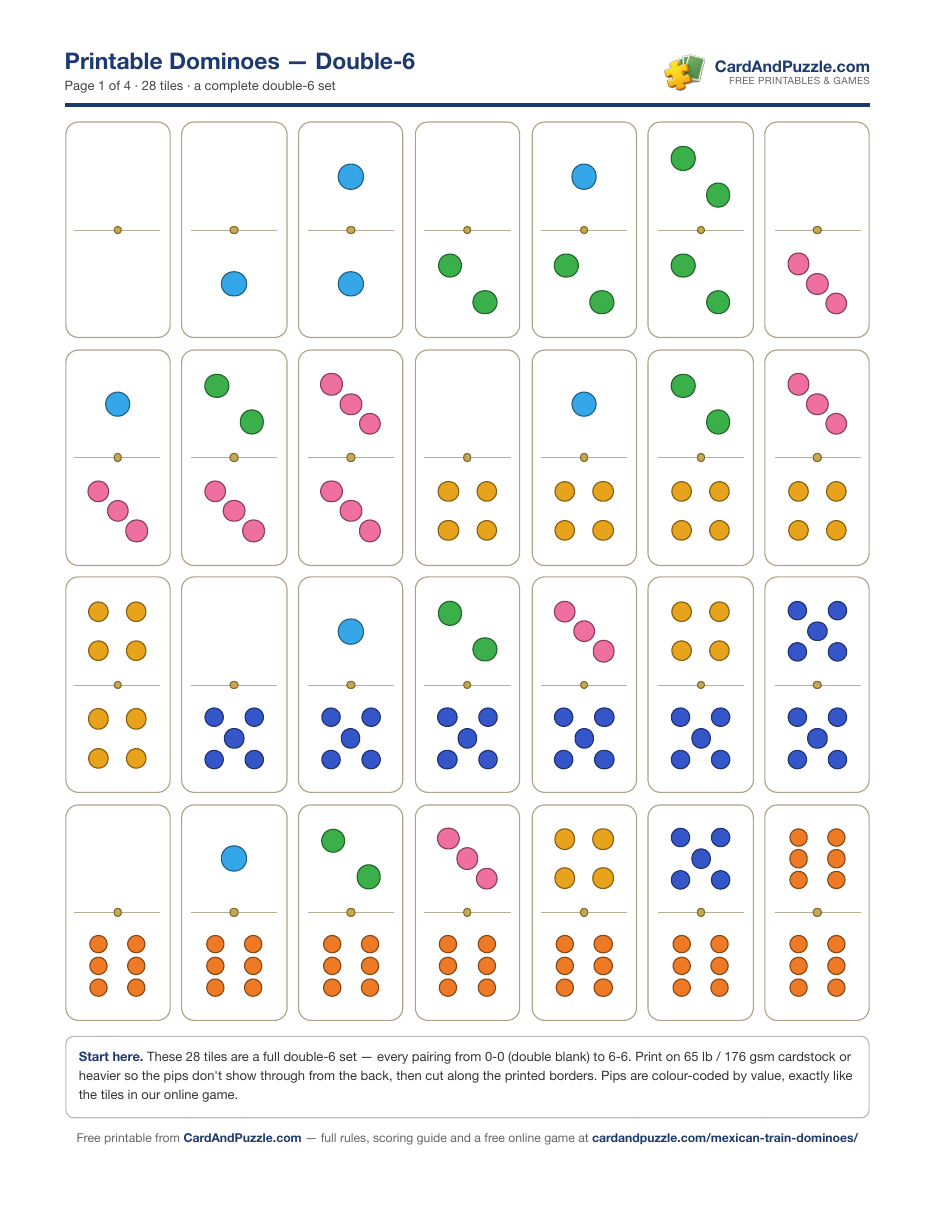
Você não precisa de um dominó de verdade para jogar Trem Mexicano hoje à noite. Este é um conjunto de dominó para imprimir, gratuito e com os pontos já impressos: quatro páginas que formam um conjunto duplo-12 completo de 91 pedras, com o mesmo código de cores das pedras do nosso jogo online. Imprima em papel-cartão, recorte pelas bordas e você terá um conjunto capaz de sustentar um jogo completo de 13 rodadas.
As páginas estão organizadas para você poder parar antes: a página 1 sozinha já é um conjunto duplo-6 completo, as páginas 1–2 formam um conjunto duplo-9, e as quatro juntas dão o conjunto duplo-12 que o Trem Mexicano usa.
O que vem no download?
Quatro páginas em tamanho carta (também imprimem em A4), 28 pedras por página:
| Recorte estas páginas | Você fica com | Pedras | Serve para |
|---|---|---|---|
| Página 1 | Conjunto duplo-6 | 28 | Dominó clássico, Muggins, jogos infantis |
| Páginas 1–2 | Conjunto duplo-9 | 55 | Trem Mexicano para 2–4 jogadores |
| Páginas 1–4 | Conjunto duplo-12 | 91 | Trem Mexicano até 8 jogadores, Chicken Foot |
Como as folhas se encaixam, nada é desperdiçado se você só precisa de um conjunto pequeno — e sempre dá para imprimir as páginas 2 a 4 depois para ampliar. A página 2 inclui uma pedra em branco extra como reserva, e a página 4 traz um guia de corte mais um resumo de uma página do Trem Mexicano, impresso ao lado das últimas oito pedras.
De qual conjunto de dominó eu preciso?
Para o Trem Mexicano, a resposta é quase sempre duplo-12. É o conjunto em torno do qual o jogo foi construído: 13 rodadas, uma para cada locomotiva, da 12-12 até a carroça branca, e 91 pedras bastam para oito jogadores comprarem uma mão cheia e ainda sobrar monte de compra. Um conjunto duplo-9 funciona bem para grupos menores e encurta o jogo para 10 rodadas.
Para todo o resto — dominó bloqueado e outras variações, Muggins, Fives-and-Threes, jogos de combinar com crianças — um conjunto duplo-6 é a escolha tradicional, e a página 1 dá conta dele sozinha.
Pontos coloridos, iguais aos do jogo online
Cada valor tem a própria cor de pontos: o 1 é azul, o 2 verde, o 3 rosa, o 4 dourado, o 5 azul-escuro, e assim por diante até o 12 quase preto. É o mesmo código de cores que os conjuntos duplo-12 físicos usam, e são as mesmas cores das pedras no nosso Trem Mexicano online. Depois de uma rodada de qualquer um dos dois jeitos, você para de contar pontos: um 11 é simplesmente marrom.
Isso importa mais do que parece na escala do duplo-12. Uma mão com metades de 9, 11 e 12 é muito ponto para ler um a um, e a cor transforma isso em uma olhada.
Como as pedras de valor alto são desenhadas?
Pontos acima de seis não cabem numa face de dado, então este conjunto usa a disposição que a maioria dos conjuntos duplo-9 e duplo-12 adota: duas colunas externas de pontos com uma coluna central entre elas.
- 7 é 3-1-3, 8 é 3-2-3, 9 é 3-3-3
- 10 é 4-2-4, 11 é 4-3-4, 12 é 4-4-4 (uma grade limpa de 3 × 4)
Os valores são lidos por coluna, então uma metade continua legível a um braço de distância do outro lado da mesa. Metades que valem zero saem impressas em branco, exatamente como num conjunto de verdade.
Dominó de papel dá para jogar mesmo?
Dá — e o Trem Mexicano é justamente o jogo que combina melhor com ele, porque tudo acontece deitado na mesa. A locomotiva vai no centro, os trens crescem para fora, as carroças ficam atravessadas. Nada precisa ficar em pé, então a única coisa que pedras de papel não conseguem fazer nunca aparece.
As diferenças práticas são pequenas e fáceis de contornar:
- Sua mão. Deixe-a virada para baixo na sua frente e levante as pedras para olhar, ou dobre uma tira de papel-cartão no comprimento para virar um suporte. Muitos conjuntos de loja também precisam de um.
- Embaralhar. Pedras de papel não deslizam como as de plástico. Empurre-as viradas para baixo em um monte solto em vez de rodopiar — mesmo resultado, sem virar nada.
- Peso. Pedras de papel-cartão podem escorregar se alguém esbarrar na mesa. Jogar sobre uma toalha ou um jogo americano resolve por completo.
Regras e pontuação são idênticas, e as cores impressas batem com as do jogo online, então alternar entre papel e tela no meio da semana não parece jogar dois jogos diferentes.
Dicas de impressão que realmente importam
Use papel-cartão. É isso que decide se o seu conjunto parece um dominó ou recortes de papel. A partir de 176 g/m², os pontos não vazam para o outro lado quando as pedras estão viradas para baixo — com papel comum, qualquer um do outro lado lê sua mão pelo verso. Com 300 g/m² fica ainda melhor, se a sua impressora aceitar.
Imprima colorido e em escala de 100 %. Desative «ajustar à página» ou «reduzir para caber» para que todas as folhas sejam recortadas no mesmo tamanho. A cor é o que torna os valores altos legíveis de relance; uma impressão em tons de cinza ainda funciona, porque cada valor tem também a própria disposição de pontos. As faces ficam brancas de propósito: a tinta vai para os pontos, não para tingir 91 pedras.
Corte com guilhotina, se tiver uma. Uma guilhotina de papel dá as bordas retas que permitem empilhar e embaralhar direito; tesoura funciona, mas costuma fugir da linha.
Plastifique para uso repetido. Para uma sala de aula, um centro de convivência ou qualquer lugar em que o conjunto passe por muitas mãos, plastificar depois de cortar triplica mais ou menos a vida útil. Um saquinho zip evita que as pedras de papel empenem entre uma noite de jogo e outra.
Quer desenhar os próprios pontos ou acrescentar reposições a um conjunto que já tem? O modelo de pedras em branco usa o mesmo tamanho de pedra, então os dois downloads se embaralham juntos.
Pronto para jogar?
Recorte seu conjunto e pegue a folha de pontuação para imprimir para a contabilidade e as regras em letra grande se alguém na mesa quiser uma referência que consiga mesmo ler. Novo no jogo? As regras e o guia de pontuação cobrem tudo, da primeira distribuição à soma final.
Sem impressora, ou sem papel-cartão em casa? Nosso Trem Mexicano online gratuito usa um conjunto duplo-12 completo, distribui e pontua cada rodada por você e roda no navegador — sozinho contra bots ou passando o aparelho com até 4 jogadores.
Mais materiais para imprimir
- Folha de Pontuação — Uma página, até 8 jogadores, as 13 rodadas completas
- Regras em Letras Grandes — As regras padrão em tipos de 16pt+ e alto contraste
- Dominós em Branco — 28 pedras em branco recortáveis por página
- Ver todos os materiais para imprimir
Prefere dispensar o papel? Jogue Dominó Trem Mexicano grátis no navegador — a pontuação é automática.
Jogar Dominó Trem Mexicano