Mexican Train Dominoes
Game preview
Board & Tile GamesUpdated
Mexican Train Dominoes
The Beloved Family Dominoes Game — Free Online
Mexican Train is the game that turned dominoes into a family institution. It's played at kitchen tables, senior centers, and holiday gatherings across the country, and once you've heard the click of tiles and watched someone dramatically cover your open double, you understand why. I built this version because I wanted the same game — the real rules, the real tension — playable in ten seconds from any browser. It's completely free, there's nothing to download or sign up for, and it works just as well on a phone as on a desktop.
Play solo against one to three computer opponents with Easy, Medium, or Hard difficulty, or pass the device around the table for a classic family game with up to 4 players — any mix of humans and bots.
How Do You Play Mexican Train Dominoes?
The goal is simple: get rid of your dominoes, because every pip left in your hand at the end of a round counts against you. Lowest total score after all rounds wins. Here's the shape of a round:
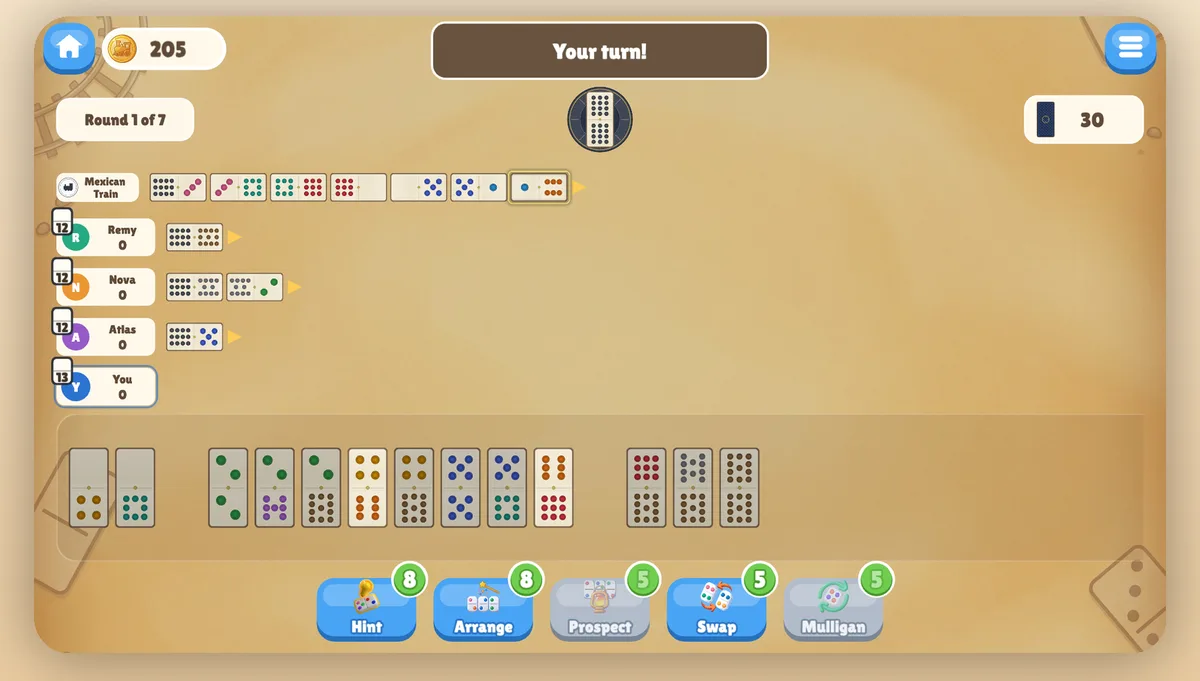
- The engine: Each round starts with a double in the center hub — the double-12 in round one, counting down each round after that. Every train grows out from it.
- Your train: You build your own personal chain from the engine, matching numbers end to end. A 12 touches a 12, a 7 touches a 7.
- The Mexican Train: One shared train is open to everyone, all game long. Anyone can start it or extend it.
- Your turn: Play one tile on your train, the Mexican Train, or any opponent's train that has a marker on it. If you can't play, draw one tile — and if that doesn't fit either, a marker goes on your train and everyone else can build on it until you play on it again.
- Doubles: Play a double sideways and you immediately get an extra play — but that double must be covered, and until it is, it's the only place anyone can play.
- Going out: The round ends the moment someone plays their last tile. They score zero; everyone else counts the pips left in their hand.
New to the game? Read the step-by-step beginner walkthrough → Or settle an argument fast with the complete rules reference.
Choose Your Game
When you press Play, the setup screen lets you shape the match:
- Players: Solo with 1–3 bots, or pass-and-play with friends at the same table — 2-player, 3-player or 4-player.
- Length: Quick (1 round), Blitz (3 rounds), Short (7 rounds), or the Full classic 13-round game from the double-12 down to the double-blank.
- Difficulty: Easy bots play casually, Medium plays a solid family-table game, and Hard plays close to optimally. The difficulty you pick is the difficulty you get — the game never secretly adjusts.
- Daily Challenge: one shared, date-seeded deal for the whole world. Same tiles, same bots, every device — compare scores fairly.
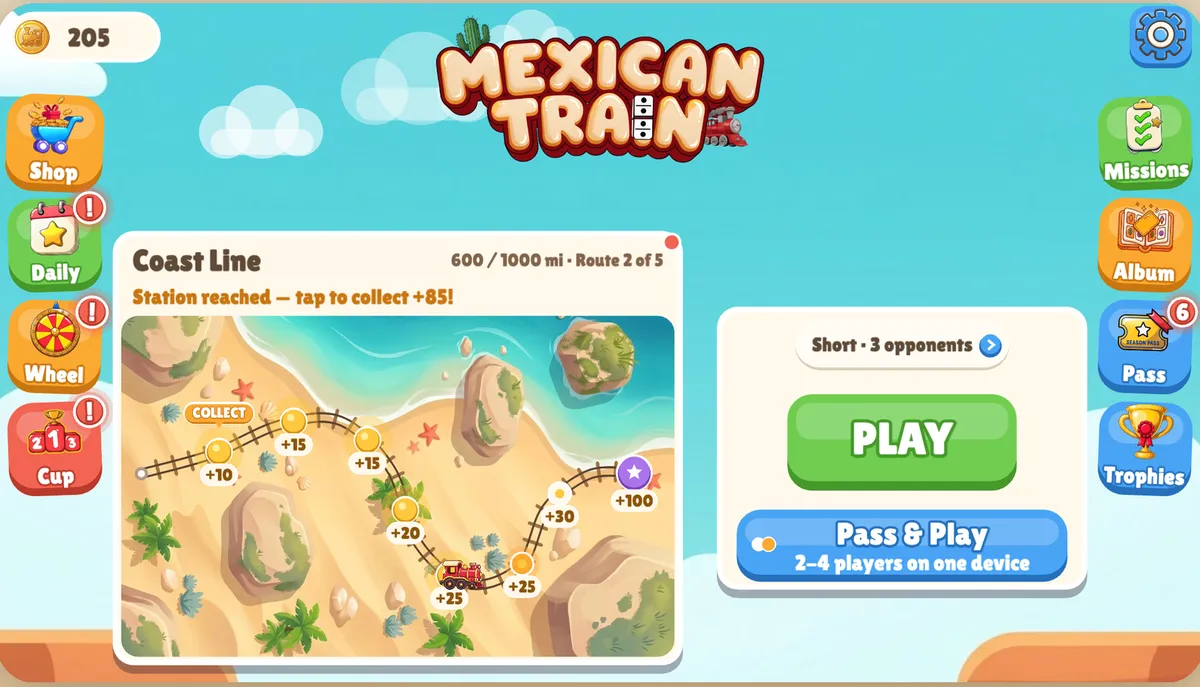
The game uses the standard double-12 set of 91 tiles, the same set boxed Mexican Train games ship with.
Can You Play Mexican Train With Friends?
Yes — pick Pass & Play in the setup screen and up to 4 people share a single phone, tablet or computer. Turns move around the table exactly like a real game: each player is prompted by name, and the previous hand is hidden before the device changes hands, so nobody sees your tiles. Short a player? Seat a bot or two and the table still fills.
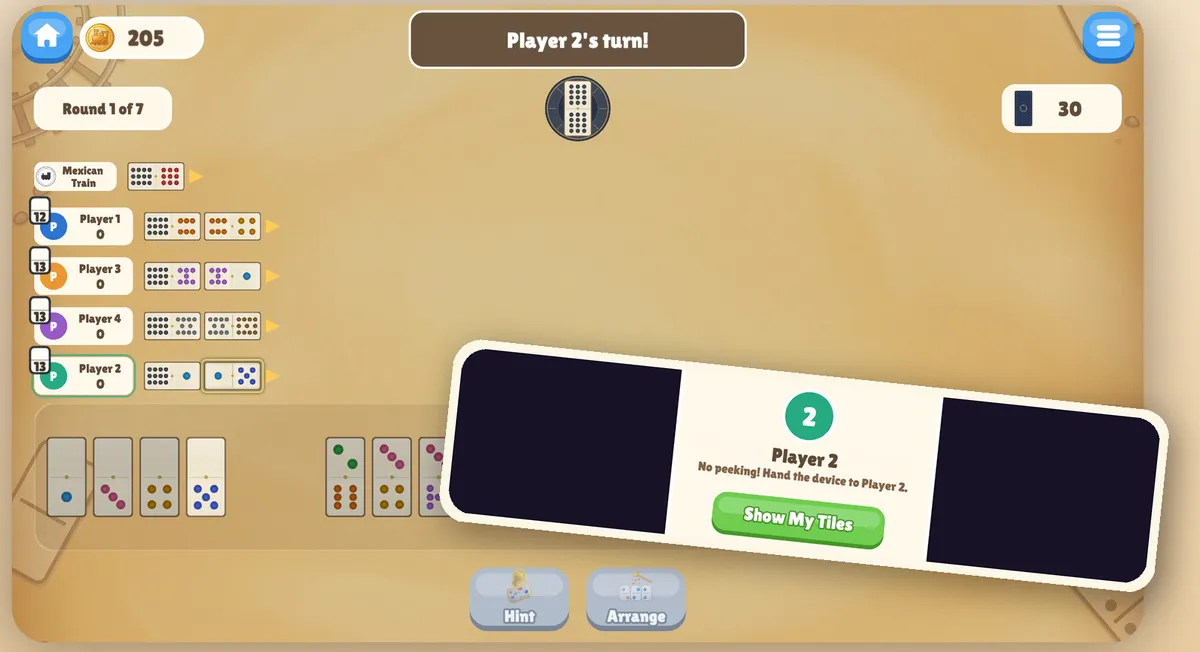
It is the feature the native dominoes apps lead with in their store listings — except here there is nothing to install, on anyone's device. One person pulls up the page and four people are playing inside a minute. That suits the moment Mexican Train usually happens: a holiday table, a cabin, a long afternoon at the kitchen counter, and no domino set in the house.
To be straight about the limits — this is local play on one shared device. There is no online multiplayer, so you can't deal a hand with someone in another city. If that's what you were hoping for, tell us; knowing how many people are asking is genuinely useful.
Fair Deals, Every Time
Dominoes players are rightly suspicious of digital shuffles — nobody wants to lose to an algorithm with a thumb on the scale. So here's exactly how this game works: every match is dealt from a random seed that's saved with your game. Close the tab mid-round and come back tomorrow, and the same tiles are waiting in the same order. The deal is never regenerated, never nudged toward or against you, and bot difficulty never changes unless you change it. That's the whole story — the same fairness you'd get from a well-shuffled physical set.
Learn, Improve, Win
Mexican Train rewards planning far more than it first appears. The full cluster of guides lives here:
- Rules — the complete reference, including every edge case and common house-rule variation.
- How to Play — a beginner's walkthrough of one full round, no experience assumed.
- Scoring — pip counting, sample scorecards, and tiebreakers.
- Strategy — hand organization, double timing, and endgame play that measurably lowers your scores.
- Variations — house rules, other set sizes, and the traditional Cuban relative Longana.
- Mexican Train vs Chicken Foot — the two games compared side by side, and which one suits your group.
- History — why a game popularized in 1990s America is called the Mexican Train (the answer is a better story than you'd think).
Playing at a real table instead? Grab our free printables — a score sheet for up to 8 players, large-print rules, and blank domino tiles. And if your group uses a smaller set, we cover double-9 and double-6 play too.
Why Mexican Train Is Worth Learning
Plenty of games are easy to learn; not many stay interesting for decades. Mexican Train hits that balance because every round hands you a genuinely new puzzle: how to arrange fifteen random tiles into the longest, cleanest chain, what to keep in reserve, and when to spend a double for maximum damage. There's enough luck that a first-timer can beat a veteran on any given round — which is exactly what you want in a family game — and enough skill that over thirteen rounds, good decisions win.
It's also one of the most social games ever put on a table. Turns are fast, nobody is eliminated, and the open-train mechanic means you're always watching everyone's moves, not just your own. If you grew up with it, this version will feel like home. If you've never played, the walkthrough and a couple of rounds against Easy bots will have you comfortable in ten minutes.
Frequently Asked Questions
How do you play Mexican Train Dominoes?
Each round starts with a double placed in the center — the engine. Every player builds their own train of dominoes out from it, matching numbers end to end, while one shared Mexican Train is open to everyone. On your turn you play one matching tile on your own train, the Mexican Train, or any opponent train that has a marker on it. If you cannot play, you draw one tile; if it still does not fit, your train is marked open for everyone. The round ends when someone plays their last tile, and the lowest total score after all rounds wins.
Can I play Mexican Train Dominoes online for free?
Yes. The version here on Card & Puzzle is completely free, runs in your browser, and needs no download or sign-up. You can play solo against one to three computer opponents or hand the device around for pass-and-play with up to 4 players.
How many people can play Mexican Train Dominoes?
The tabletop game plays well with 2 to 8 people using a double-12 set, and even more with larger sets. Our online version seats up to 4 players — any mix of humans and bots — which is widely considered the sweet spot for pacing and strategy.
Is Mexican Train Dominoes multiplayer?
Choose Pass & Play in the setup screen and up to 4 people share one phone, tablet or computer, taking turns exactly as you would around a real table. The game prompts each player by name when it is their turn and hides the previous hand, so nobody sees your tiles, and you can fill any empty seats with bots. There is no online multiplayer, so everyone needs to be together in the same room. If an online version is something you would want, let us know through the contact page.
What domino set do you need for Mexican Train?
The standard is a double-12 set with 91 tiles, which is what boxed Mexican Train games ship with and what our online game uses. You can also play at a physical table with a double-9 set (55 tiles) for smaller groups, or even a household double-6 set in a pinch.
Is this Mexican Train game rigged or random?
Every deal is genuinely random and driven by a saved seed, which means your match can be paused and resumed with the exact same tiles — nothing is reshuffled behind your back, and the game never adjusts the deal to help or hurt you. Bot difficulty is an explicit setting you choose, not something that changes mid-game.
How long does a game of Mexican Train take?
Online you choose the length: Quick is a single round, Blitz is 3 rounds, Short is 7, and Full is the classic 13-round game running the double-12 down to the double-blank. A single round typically takes a few minutes online; a full 13-round tabletop game usually runs a long evening.
Can I play Mexican Train Dominoes on my phone?
Yes. The game is fully optimized for phones, tablets, and desktops — same free game, no app required.
What is the Daily Challenge?
Every day there is one shared deal generated from the date, so every player in the world faces the identical tiles and bots. Play it once and see how your score stacks up.
Further Reading
- Play Mexican Train Dominoes Online — Browser, iPhone, and Android
Every way to play Mexican Train Dominoes online: free in your browser with no download, or with the Mexican Train Dominoes Journey app on iPhone and Android. Solo vs. bots, pass-and-play, and a daily challenge.
- How to Play Mexican Train Dominoes – A Beginner Walkthrough
Learn Mexican Train dominoes in one read: a friendly step-by-step walkthrough of setup, your first turn, doubles, and scoring, with a full example round.
- Free Mexican Train Dominoes Printables
Free printable Mexican Train dominoes downloads: a full double-12 domino set, an 8-player score sheet, large-print rules and blank tile templates. No sign-up.