Mexican Train Dominoes Rules – The Complete Reference
Complete Mexican Train dominoes rules: setup, hand sizes, doubles, train markers, scoring, and clear answers to every edge case and common house rule.
Updated
Table of Contents
I built this page to be the one rules reference you keep open at the table. Every setup number, every doubles ruling, every edge case that starts an argument mid-round — it’s all here, in order, with honest notes wherever published rule sets genuinely disagree. If you’d rather learn by walking through a game, start with the beginner walkthrough instead; this page is built for looking things up.
Mexican Train in Eight Bullets
- Each round starts with one double (the engine) in the center; every train must ultimately grow from it.
- Players draw a hand of tiles; the rest form the boneyard (draw pile).
- On your turn you play one tile whose end matches the open end of an eligible train.
- You always have your own personal train, and there is one communal Mexican Train anyone may play on.
- Can’t play? Draw one tile. Still can’t? Mark your train — it’s now open for everyone until you play on it again.
- Play a double and you owe an extra tile; in most rule sets an uncovered double freezes the whole table until someone covers it.
- The round ends when someone plays their last tile (or nobody can move); everyone else scores the pips left in their hand. Lowest total wins.
- A full double-12 game is 13 rounds, with the engine counting down from double-12 to double-blank.
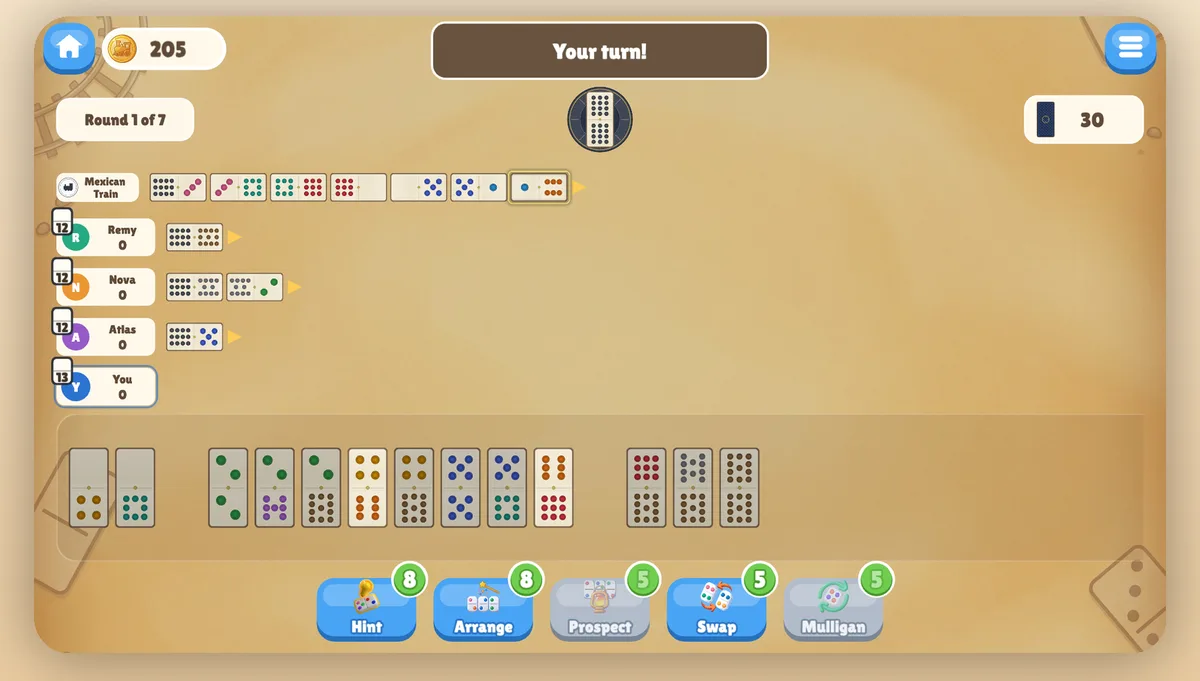
What You Need to Play
Mexican Train is played with a double-12 domino set — 91 tiles covering every combination from 0-0 to 12-12. That’s the set boxed Mexican Train products ship with, and it comfortably handles 2 to 8 players. Smaller and larger sets work too: a double-9 set (55 tiles) suits 2-4 players, and the double-6 set (28 tiles) most households already own handles 2-3. Oversized double-15 (136 tiles) and double-18 (190 tiles) sets exist for very large tables.
Beyond tiles, you need:
- A station (hub) — the centerpiece the engine sits in, with slots for each train. Boxed sets include one; a bare table works fine without it.
- Train markers — one per player, used to flag an open train. Boxed sets include little metal trains, but pennies, poker chips, or candy all do the job.
- A score sheet and pencil. Our free printable Mexican Train score sheet has a column per player and a row per round.
If someone at your table needs bigger text, we also offer the same rules as a large-print printable.
Setup and Hand Sizes
Shuffle all tiles face down, deal each player a hand, and push the rest aside as the boneyard. Players stand their tiles on edge or hold them so nobody else can see them.
How many tiles does each player take? This is the single most-argued number in Mexican Train, because published rule sets genuinely disagree — usually by a tile or two. Here is a common dealing chart for the standard double-12 set, from widely used boxed-set instructions:
| Players | Tiles each (double-12 set) |
|---|---|
| 2 | 16 |
| 3 | 15 |
| 4 | 14 |
| 5 | 12 |
| 6 | 11 |
| 7 | 10 |
| 8 | 9 |
Another widely used chart is simpler: 2-4 players take 15 each, 5-6 take 12, and 7-8 take 10. Either works. The exact count doesn’t affect fairness as long as everyone draws the same number and enough tiles remain in the boneyard.
For the smaller sets:
- Double-9 (55 tiles), 2-4 players: published deals range surprisingly widely, from 7 tiles each all the way to 15. The Puremco-lineage chart deals 15 tiles for 2 players, 13 for 3, and 10 for 4.
- Double-6 (28 tiles), 2-3 players: 5 tiles each is a common recommendation. With so few tiles, expect a fast, drawing-heavy round.
Playing head-to-head, three-handed, or with the classic four seats? The 2-player, 3-player and 4-player pages cover pacing and adjustments for those counts, and the double-12 page goes deeper on the standard set itself.
Starting the Round: The Engine
The center double is called the engine, and the hub it sits in is the station. In round one the engine is the double-12; each following round uses the next double down (double-11, double-10, and so on).
There are two well-established ways to get the engine into the center — pick one and stay consistent:
- Method A — set it aside before dealing (the boxed-set method, and the simpler one for beginners): find the double-12, place it in the station, then shuffle and deal. The first player is decided separately — commonly, everyone draws one tile and the highest pip count goes first, with the start rotating clockwise each round after that. Some groups simply designate a starter and rotate from there.
- Method B — whoever holds it plays it (the traditional method): shuffle and deal everything. The player dealt the double-12 plays it to open the round and takes the first turn. If nobody holds it, players draw equally from the boneyard until it turns up.
Most groups play one of these two; there is no meaningful difference in fairness. Play proceeds clockwise.
Your First Turn
On your first turn you start your personal train: a chain of tiles growing out of the station toward you, beginning with a tile that matches the engine (in round one, any tile with a 12 on it).
How much you may play on that first turn is one of the game’s genuine rule splits:
- Many groups — and the pagat.com and University Games rules — let you lay your entire starting string on turn one: as many tiles from your hand as you can chain into a valid train (12-8, 8-3, 3-3, 3-11…). Under these rules you may not play on anyone else’s train or start the Mexican Train during your first turn.
- The Puremco-lineage rules play one tile per turn from the very start. You still plan your longest train during setup — you just lay it down one tile at a time.
Most groups play one or the other without realizing an alternative exists, which is why this argument erupts whenever two families merge tables. Agree before you deal. On Card & Puzzle, our online game plays one tile per turn from the first turn.
If you can’t play anything on your first turn, the normal draw-and-mark rules below apply.
Later Turns: One Tile, and You Must Play It
From the second turn on (or from turn one, in one-tile groups), the rhythm is fixed:
- Play exactly one tile whose end matches the open end of an eligible train — with the exception of doubles, which earn an extra play (see Doubles).
- If you hold a playable tile, you must play it. Passing for strategic reasons is not an option in the standard rules.
- If you can’t play, draw one tile from the boneyard. If it’s playable, play it immediately. If not, your turn ends and you mark your train.
Eligible trains are: your own personal train (always), the Mexican Train (always, once started), and any other player’s train currently marked open.
Trains: Personal, Open, and the Mexican Train
Your personal train starts private — only you may play on it. It stays private until the moment you fail to play: after your one draw, if you still can’t place a tile, you put your marker on your train. A marked train is open: any player may extend it on their turn.
You keep taking normal turns while your train is marked, and you may play on any eligible train. The marker comes off — and your train reverts to private — as soon as you play a tile on your own train.
The Mexican Train is a separate, communal train that belongs to nobody:
- It’s always public. Anyone may start it or extend it on their turn; it is never closed.
- Its first tile must match the engine, just like a personal train.
- It may be started by any player on any turn — though under the multi-tile first-turn rules, not during a player’s own first turn.
- There is only one Mexican Train per round. (Groups playing oversized double-15 or double-18 sets sometimes allow more as a house rule.)
Some tables put a marker on the Mexican Train too, purely as a reminder that it’s open to everyone.
Doubles
Doubles are the engine room of Mexican Train drama. Four rules cover almost everything:
1. A double is placed sideways (perpendicular to the train), and playing one earns you an obligation: you must immediately play one more tile.
2. Where that extra tile goes is a genuine rules split. Under the Puremco-lineage and most boxed rules, the extra tile may go on any eligible train — it does not have to cover the double you just played. Some house rules require you to cover your own double immediately if you can. On Card & Puzzle, our online game requires the extra tile to close the double.
3. An uncovered double blocks the table. Until an open double is satisfied (covered by a matching tile at its exposed end), it is the only legal place to play — for everyone. The obligation passes around the table: each player must cover it if they can; if they can’t, they draw one tile, play it on the double if possible, and otherwise mark their own train. Most groups play this blocking rule; note, though, that the University Games boxed instructions omit it entirely, so players who learned from that box genuinely play with doubles that never block. Settle it before the round starts.
4. You may chain doubles. Play a double, and if your required extra tile is itself a double, you owe yet another tile — you can lay two, three, or more doubles in succession as long as you finish with a non-double. A popular ordering rule says doubles must be satisfied in the order they were played. Some groups instead allow only one double per turn; that’s a known variant.
If you play a double and can’t produce the required extra tile, draw one; if that doesn’t help, your turn ends, your train is marked, and the open double starts blocking the table.
The dead double exception: if every matching tile is already on the table (all thirteen 8s are down, say, leaving nothing that can ever cover the 8-8), the double no longer needs covering and stops blocking play.
Drawing and Passing
The boneyard rules are mercifully unanimous across every major rule set:
- You draw exactly one tile, and only when you have no legal play.
- If the drawn tile is playable, you play it immediately and your turn ends normally.
- If it isn’t, your turn ends and you mark your train.
- If the boneyard is empty, you simply pass and mark your train. You never skip your turn while holding a playable tile — you must play if you can.
Going Out and Ending the Round
The round ends the moment a player plays their final tile — they have dominoed and score zero for the round.
The tap rule: in most rule sets, when you’re down to one tile you must warn the table, traditionally by tapping the tile on the table (some groups knock, or call out). A common penalty for forgetting is drawing two tiles. Some rule sets treat the announcement as optional courtesy; agree on your table’s version up front. There’s no announcement mechanic in our online game — the tile counts are simply visible.
A round can also end blocked: if the boneyard is empty and nobody can play, the round is over. Everyone — including whoever is closest to going out — counts the pips left in their hand.
Scoring in Brief
At the end of each round, the player who went out scores 0; everyone else scores the sum of the pips on the tiles still in their hand. Scores accumulate across rounds, and the lowest total after the final round wins.
Two details worth knowing:
- The double-blank is worth 0 under standard scoring — every pip counts, and it has none. A popular house rule, borrowed from Chicken Foot, makes it worth 50 points instead.
- The most commonly cited tiebreaker: if totals are equal at game end, the player who won more rounds (scored more zeros) wins; if still tied, the lowest single-round score other than zero decides it.
For pip-counting technique, a sample filled-in scorecard, and every scoring variation, see the full scoring guide — and grab the printable score sheet before game night.
The 13-Round Game
A full game with a double-12 set is 13 rounds: the engine starts at double-12 and steps down each round — 11-11, 10-10, and so on — until the final round opens with the double-blank. With a double-9 set the same structure gives 10 rounds; played the same way, a double-6 game runs 7 rounds (6-6 down to double-blank).
Between rounds, all tiles are reshuffled, hands are re-dealt at the same sizes, and the start rotates (or, under Method B, passes to whoever holds the new engine).
Expect roughly 20-30 minutes per round with four players, so plan a long evening — around three hours or more — for all 13 rounds. Many groups happily agree on fewer rounds; shortened games are completely standard.
Edge Cases, Answered
Can you play on another player’s train?
Only while it’s marked open. The moment its owner plays a tile on it, the marker comes off and it’s private again. The Mexican Train, by contrast, is open to everyone all round long.
What if nobody can make a legal play?
If the boneyard still has tiles, that can’t happen — anyone without a play draws. Once the boneyard is empty, players without a play pass and mark their trains; if a full circuit passes with no plays, the round is blocked and everyone scores their remaining pips.
Can you end the round on a double?
Most groups say yes: under the Puremco-lineage and pagat.com rules, playing a double as your last tile ends the round immediately, with nothing owed. Many house rules forbid it, requiring a non-double finish — decide before you deal. Our online game allows going out on a double.
Can you play more than one double in a turn?
Yes, in the standard rules — each double you play obligates another tile, so you can chain doubles as long as you end on a non-double. Doubles are then commonly satisfied in the order they were played. Some groups limit players to one double per turn as a house rule.
Do you have to play a tile if you can?
Yes. In every major rule set, holding back a playable tile for strategy is illegal. You draw only when you genuinely have no legal play.
What if a double can never be covered?
When every matching tile is already on the table, the double is dead: it no longer needs satisfying and stops blocking the table.
When can the Mexican Train be started?
By any player on any turn — except, under multi-tile first-turn rules, during that player’s own first turn. Its first tile must match the engine.
Play Mexican Train Online
The fastest way to internalize these rules is a few practice rounds. You can play Mexican Train free in your browser — no download, no sign-up — solo against 1-3 AI bots or in local pass-and-play with up to 4 players at one device, on phone, tablet, or desktop. Every deal is genuinely random and reproducible from its seed, so there are no rigged shuffles and no difficulty rubber-banding — just the game, played straight.