How to Play Mexican Train Dominoes – A Beginner Walkthrough
Learn Mexican Train dominoes in one read: a friendly step-by-step walkthrough of setup, your first turn, doubles, and scoring, with a full example round.
Updated
Table of Contents
Mexican Train is my favorite kind of game to teach: the whole thing is just matching numbers, and a brand-new player can hold their own in the very first round. This walkthrough assumes you’ve never touched a domino. We’ll set up a real four-player table — you, Maria, Sam, and Grandma — and play through a round together, one decision at a time. When you want the strict reference version of any rule, the complete rules page has every detail and edge case.
What You Need
You need a double-12 domino set: 91 tiles showing every pairing of pips from 0-0 (the double-blank) up to 12-12. Boxed Mexican Train sets also include a station — a hub for the center of the table — and a little train marker for each player. None of the plastic matters much: a bare table works instead of a station, and pennies work as markers.
Add a pencil and a score sheet (our printable score sheet is made for exactly this) and you’re equipped for years of game nights.
Set Up the Table
Tonight it’s you, Maria, Sam, and Grandma. Setup takes about a minute:
- Find the double-12 and place it in the center station. This tile is called the engine, and every train in this round will grow out of it.
- Shuffle everything else face down with a good swirl of the hands.
- Everyone draws a hand — with four players, 14 tiles each is a common deal (some charts say 15; any number is fine as long as everyone takes the same). Stand your tiles on edge facing you so nobody else can see them.
- Push the leftover tiles to the side, face down. That pile is the boneyard — you’ll draw from it when you’re stuck.
To pick a starter, each of you draws one extra tile from the boneyard and shows it; the highest pip total goes first, and those tiles go back in. Maria turns over an 11-9, the best of the four, so she’ll lead off, with play passing clockwise: Maria, Sam, Grandma, then you.
Sort Your Hand Into a Train
Before anyone plays, take a quiet minute to organize. Your goal for the round is to empty your hand, and your main outlet is your personal train — a chain of tiles that grows from the engine toward you, each tile matching the one before it end to end.
The engine is a 12, so your train has to start with a tile that has a 12 on it. Look at your 14 tiles and chain as many as you can: you find 12-10, then 10-4, then 4-7. That’s a three-tile train — 12 connects to the engine, 10 connects to 4, 4 connects to 7 — leaving a 7 as your open end. The rest of your hand doesn’t chain in yet; those tiles wait at the side for later.
This sorting step is where games are quietly won. A long starting chain means fewer leftover tiles, and leftover tiles are what count against you at scoring time.
Your First Turn
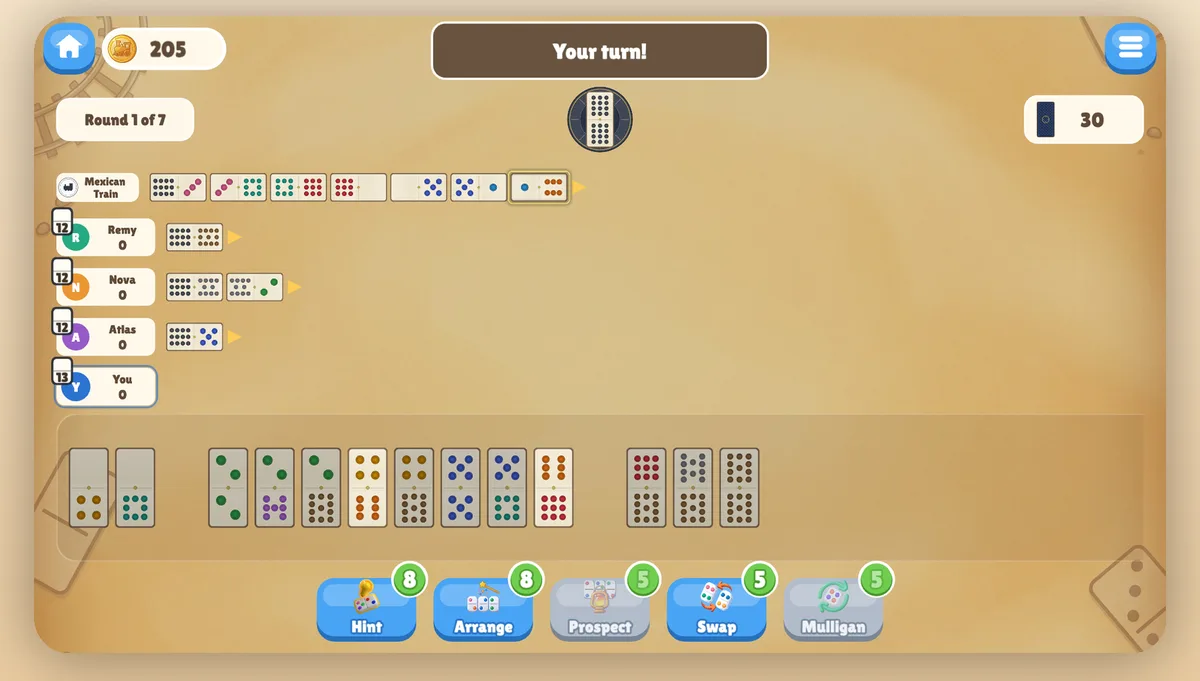
Maria goes first and does something dramatic: she lays her entire starting chain at once — 12-3, 3-3, 3-8, 8-1, 1-5, five tiles in one go — building her personal train out of the station. Most groups play the first turn this way: on turn one only, you may lay as many tiles as you can chain into a valid train. (Some tables instead play one tile per turn from the very start — the Puremco-lineage way, and the way our online game plays it. Agree before you deal.)
Two things you may not do on a multi-tile first turn: play on another player’s train, or start the Mexican Train (more on that shortly).
Sam has only one 12 in his whole hand, so his first turn is a single tile: 12-5. Grandma lays 12-9 then 9-2. You lay your three: 12-10, 10-4, 4-7. After one circuit of the table, four trains stretch out of the station like spokes, and the round proper begins.
Taking Turns: Match, Draw, or Mark
From now on, every turn is the same simple loop: play exactly one tile that matches the open end of a train you’re allowed to play on. You’re always allowed to play on your own train. And if you hold a playable tile, you must play it — no passing to be sneaky.
There’s also a shared outlet: the Mexican Train. Starting from the second turn, any player may begin it by playing a tile that matches the engine — a 12 — into an empty spot at the station. Once started, the Mexican Train is public property forever: anyone may extend it on any turn. Maria, out of useful plays on her own train, starts it with her spare 12-7. Now every player has at least two places to look each turn.
Then comes the moment every beginner meets: Sam can’t play. His train’s open end is a 5, the Mexican Train shows a 7, and nothing in his hand matches. So he follows the stuck-player ritual:
- Draw one tile from the boneyard — exactly one.
- It’s an 11-3. Not playable. So his turn ends, and he places his marker on his train.
That little train marker changes everything: Sam’s train is now open, meaning anyone may play on it. Sure enough, Grandma’s next turn is a 5-8 straight onto Sam’s train — her own way of dumping a tile, and no favor to Sam. The marker stays until Sam himself plays a tile on his own train; the moment he does, he removes it and his train is private again.
That’s the whole engine of the game: match one tile, or draw one and risk going public.
When a Double Hits the Table
A few turns later you play the 7-7 on your own train. Doubles get laid sideways, crossways to the train — and they come with strings attached: playing a double means you must immediately play one more tile. You have the 7-2, so you lay it right on the double, “covering” it, and your open end becomes a 2. One turn, two tiles, no drama.
Now imagine you hadn’t held that 7-2. An uncovered double blocks the table: in the most common rules, until someone covers the 7-7 with a matching tile, that double is the only legal place for anyone to play. Each player in turn must cover it if they can; anyone who can’t draws one tile, plays it on the double if possible, and otherwise marks their own train open. A well-timed double can strand the whole table — which is exactly why experienced players hoard them. (A few rule sets skip the blocking rule entirely, so check what your table plays; the rules page walks through every doubles variation.)
One mercy: if every matching tile is already on the table, the double is dead and stops blocking anything.
Going Out and Scoring the Round
The round races toward its end as hands shrink. When you get down to one tile, tradition says you must warn the table — usually by tapping the tile on the table. Forget, and many groups make you draw two tiles as a penalty.
You’re down to the 2-6, and your train’s open end is a 2. You tap the tile — Grandma glares, Sam groans — and on your next turn you play it. You’ve gone out (players say dominoed), and the round ends instantly.
Now everyone else counts the pips on their leftover tiles and writes down the total:
| Player | Tiles left | Round score |
|---|---|---|
| You | none | 0 |
| Maria | 6-2, 5-1 | 14 |
| Sam | 11-3, 4-0, 12-10 | 40 |
| Grandma | 9-0 | 9 |
Going out scores a perfect 0. Everyone else eats their leftovers — that’s why dumping high tiles early matters, and why Sam’s stranded 12-10 stings. (The double-blank counts 0 under standard scoring; some house rules make it 50 — settle that before you start.) The full scoring guide covers pip counting and all the variations.
Round Two and Beyond
One round is never the whole story. Shuffle everything, deal fresh hands of the same size, and start again — this time the double-11 is the engine, and every train must begin with an 11. A full game continues down through every double — 10-10, 9-9, all the way to the double-blank — for 13 rounds in all, with scores accumulating on the sheet. The start rotates each round, so Sam leads off round two.
After the final round, the lowest total score wins the game. Thirteen rounds is a long, glorious evening — around three hours or more — so plenty of groups agree up front to play fewer. If the table ends tied, the most commonly cited tiebreaker gives the win to whoever won more rounds.
Where to Go From Here
The fastest way to make all this stick is to play a round or two right now — and our bots are endlessly patient with beginners. You can play Mexican Train free in your browser, no download or sign-up, on phone, tablet, or desktop: solo against 1-3 AI bots, or pass-and-play with up to 4 players sharing one device. When a rule question comes up mid-game, the complete rules reference answers every edge case in one place. Print the score sheet, teach your own table the way you just learned, and watch out for Grandma — she hoards doubles.